WW2 Fighter Performance series
As outlined on the Projects tab, I have decided to split my previously planned book about WW2 aircraft performance into separate volumes comparing aircraft in pairs instead. And the first instalment in this planned series will compare the Spitfire Mk I and Bf 109 E during the Battle of Britain time period and is titled WW2 Fighter Aircraft Performance Volume 1: Design, aerodynamics and flight performance for the Spitfire Mk I & the Bf 109 E, Battle of Britain era.
Book cover:

Profile artwork on book cover by Claes Sundin, https://luftwaffeinprofile.se/
But since there without exaggeration probably are hundreds of books that already diligently covers the history of these two aircraft from different angles, is this not superfluous, and just adding another one to the pile?
Well no, because this book is rather different: And while other books may faithfully cover the origins, the development, the different versions, the operational usage and the pilots who flew them, when it comes to these aircraft’s performance the results are usually rather meagre.
And detailed performance analysis is what this book brings to the table: Because it’s the first to compare these two iconic fighter utilizing modern computer simulations to gauge how they truly compared: Not just repeating the same old performance numbers that have already been quoted, copied and pasted in between so many other books.
And this is looking at the entire performance envelope: Not just speed and climb, but also detailing acceleration, sustained and instantaneous turn, dive, and dive and zoom performance. And the analysis has actually uncovered some previously hidden aspects of these aircraft: Not in the least concerning turn performance. An area that has previously been considered to be a no contest win for the Spitfire. But as the simulations will show, there are exceptions to this rule, especially if the Bf 109 drops some flap. And while the Spitfire certainly was the better turning aircraft overall, the difference was in some cases not as large as common knowledge would have us believe.
In addition, the book also covers some hypothetical scenarios: What would be the effect on the Spitfire Mk I’s performance if it instead of its big wing had one about the same size as on the Bf 109? Would this have made it better or worse? Then the Bf 109 E: If it instead had had a high pressure radiator cooling system like the one the Spitfire, how much better performance would that have given it?
In summary, this book digs deeper into these aircraft’s flight performance than any previous book has ever done, introducing for example acceleration, energy retention, sustained and instantaneous turn comparisons, dive, dive and zoom comparisons all in an attempt to determine just how close or far apart or close together they were regarding each particular performance aspect. In addition, the issue of the Bf 109 E’s range is also analysed in greater detail than is usual in many other books, revealing that it was not quite as limited as it’s often made out to be. And last, but not least, in the summary and conclusions, looks into if an overall winner can be crowned.
Added to this, the book also covers background information regarding the state-of-the-art at the time in aeronautics, aircraft procurement, specifications, aerodynamics, wing design, engine and propeller technology, radiator design, armament, production costs and more.
The book is in US trade format (6″ x 9″) and is 405 pages long, and contains circa 140 figures, chart and diagrams and about 100 pictures, and is available as a paperback on Amazon:
Note that while this link is to Amazon.com, that the book is also available at (Amazon.co.uk, .de, .fr, .es, .it, .nl, .pl, .se, .be, .ie, .jp, .ca, .au).
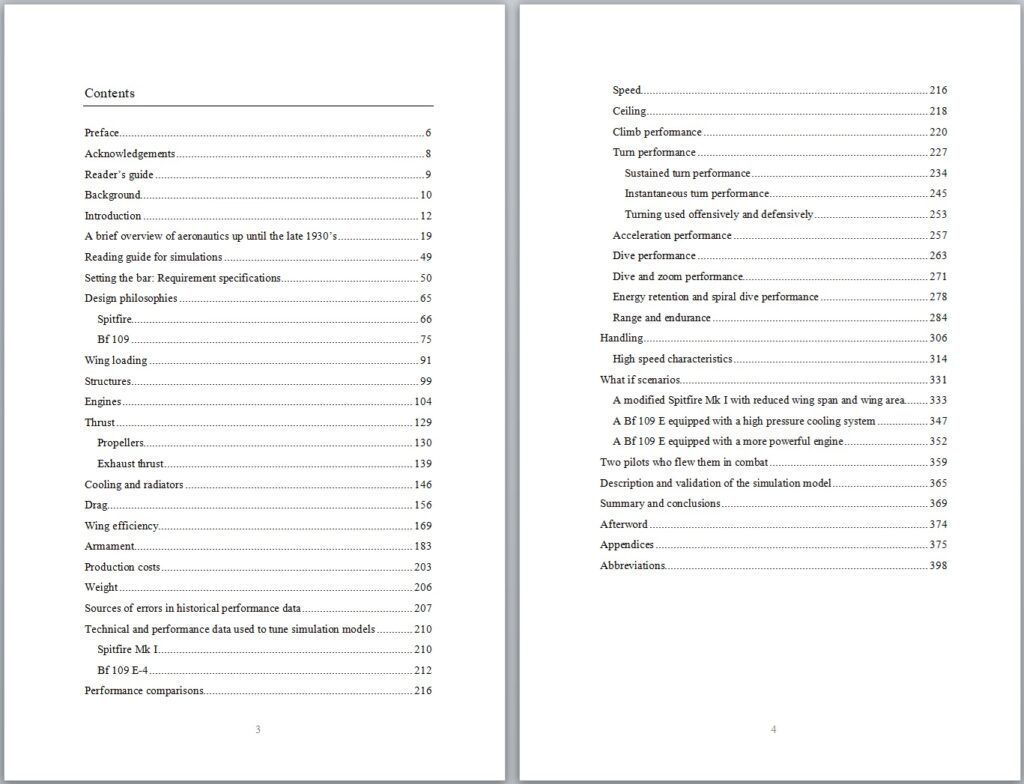
Below is a snapshot of the contents pages:
And to give an idea about the textural content, tables, charts and photos, below is a thumbnail collection of the book’s 405 pages:
Addendum and erratum to edition 1 versions 1 to 3 (Book edition and version is printed on page 2):
On page 211: The Merlin’s full throttle height should be 16,000 and not 19,000 ft in the table.
Clarification to footnote 176: The test results are with armoured windscreen and armoured fuel tank but not with the extra armour carried during the Battle of Britain.
On page 212: There is a typo regarding the 354 mph simulation top speed figure which should state a FTH of 18700, not 17400 ft. Added a row with the maximum speed 354 mph at 18,900 ft to the Spitfire’s data table. Revised the verification climb speeds to: 1 m 46 s to 5000 ft, 3 m 29 s to 10000 ft, 5 m 19 s to 15000 ft, 7 m 44 s to 20000 ft, 12 m 04 s to 26000 ft and 16 m 54 s to 30000 ft. In addition, the speeds at 10000, 15000, 20000, 26000 and 30000 ft should be 319, 339, 352, 341 and 325 mph respectively. However, note that these new numbers are only connected to the validation scenario and that all performance figures in the book remain unaffected.
Under
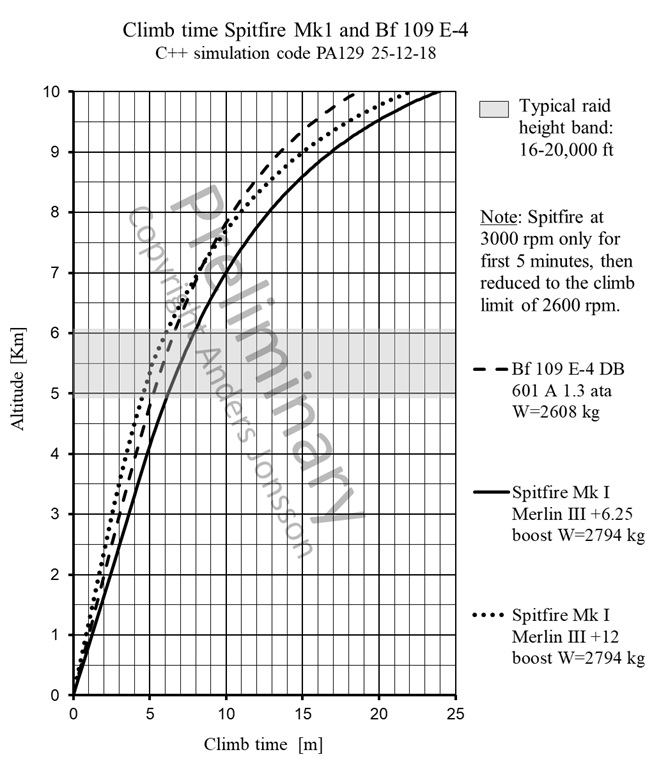
investigation: The Spitfire’s climb times
in the chart on page 225 is probably overly optimistic since it assumes that
the climb is done at 3000 rpm, while it’s more likely that the pilot would have
adhered to Pilot’s Notes and reduced the rpm to 2600 after an initial 5 minutes
of climb (see chart below). However, the chart on page 225 is still
interesting, since under combat situations, it’s not unlikely that the Spitfire
pilot would have ignored this restriction and continued at 3000 rpm. For the Bf
109 E-4 however, the climb time remains unchanged since the data sheet for the DB
601 A shows that the engine may be run with 2400 rpm for 30 minutes above 5 km
altitude.